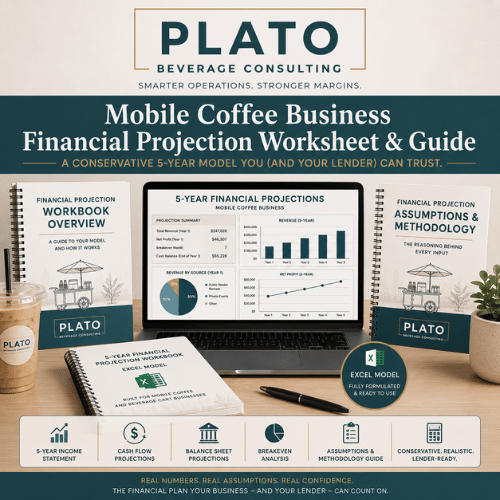
A conservative, 5-year financial projection model built specifically for an events based mobile coffee and beverage businesses. Includes overview of workbook as well as the complete assumptions and methodology behind the numbers. So you (and your lender) can trust that the numbers actually hold up.
$149
Secure checkout powered by ThriveCart. After purchase, you’ll receive immediate access to your business planning resources inside the Coffee Cart Startup learning community via an email access link.
Whether you're applying for an SBA loan, pitching an investor, or just deciding whether this business can support you personally, you need more than a business plan that sounds right. You need five years of income statement, cash flow, and balance sheet projections that are based on realistic assumptions and hold up under questions. Most first-time mobile coffee and beverage cart owners either skip this step entirely or build a spreadsheet from scratch with no real basis for the assumptions inside it.
This workbook gives you a fully built, formula-driven, conservative 5-year financial model made specifically for an events-based mobile coffee or beverage cart business. Public vendor markets, private catering bookings, seasonal traffic, and all, plus a full written explanation of exactly why every major assumption was set the way it was set. You're not just getting a spreadsheet. You're getting the reasoning behind it, so you can defend it, adjust it, and actually understand it.
What’s Included:
Know Your Numbers Before You Ask Someone else to Believe Them
The 5 Year Financial Projection Workbook (Excel)
The actual Financial Projection model: 5 input tabs covering your investment and funding assumptions, revenue and cost of goods, direct labor, other operating expenses, and salaries/owner pay, plus 7 output tabs producing your full pro forma Income Statement, Statement of Cash Flows, and Balance Sheet, monthly detail and annual summaries, along with a Breakeven and Overview tab.
The Financial Projection Workbook Overview (PDF)
A guide to how the workbook is structured, what each of its tabs does, and how they connect to one another. Read this first so you know where every input lives before you start editing.
The Financial Projection Assumptions and Methodology (PDF)
A full explanation of the reasoning behind every major input in the model: starting cash, funding structure, menu pricing and cost of goods, staffing and labor, operating expenses, and owner pay. For each one, this guide explains what it controls, what it's set to, and why.
Built Around How a Mobile Coffee Business Actually Makes Money
This isn't a generic small-business financial template with your logo dropped on top. The revenue engine is built around public vendor/farmers market events and private catering bookings, with seasonal traffic patterns, event frequency, and hours-open all driving revenue, cost of goods, and labor together. So, if your actual bookings run behind projection, your modeled costs come down with them instead of leaving you staring at a fixed budget that no longer matches reality.
Who This is For
First-time mobile coffee or beverage cart owners who need real financial projections for a lender, SBA loan officer, or investor, not just a business plan narrative.
Owners who've already built a business plan (see our Business Plan Writing Guide) and now need the numbers to back it up.
Anyone deciding between personal cash, investor funding, or a loan who wants to see how each funding mix affects breakeven timing and cash flow before committing.
Owners who are already in operation and would like a template to customize to their business needs.
Why This System Works
Every assumption in this workbook was chosen using the same test: would this hold up if things went a little slower than hoped, not just if everything went right? Traffic ramps modestly instead of assuming a fully booked calendar from month one. Staffing costs scale with actual demand rather than a fixed monthly budget. Owner and management pay stay lean early and step up only once the business has proven it can support the increase. Margins expand gradually, not aggressively.
The model also starts with more cash on hand than its own minimum cash-needed calculation says is required, rather than modeling right up to the edge. That's a deliberate choice: a plan that only works if everything goes exactly on schedule isn't a conservative plan.
This workbook was built by Derek Wasak, President of Plato Beverage Consulting, beverage industry professional, and operator of a real mobile coffee and beverage business. The assumptions inside it come from actual client and personal event, traffic, and cost data, not theory.
Frequently Asked Questions
-
After completing your purchase, you’ll receive an order confirmation followed by a separate email with a link to access the Coffee Cart Startup Community.
Your Coffee Cart Startup Learning Community account is where you’ll find all of the business planning resources included with your purchase, organized in one convenient place so you can access them whenever you need them.
Be sure to save your login information and bookmark the community page for easy access as you work through your business plan.
This will also be where you can access any additional business planning resources you purchase and get updates to products you own as we improve them.
-
No. The formulas, financial statements, and calculations are already built in. You enter your own numbers (traffic, pricing, staffing, expenses, and funding needs) into the input tabs, and the income statement, cash flow, and balance sheet calculate automatically.
-
It's built specifically for an events-based mobile coffee or beverage cart business. Public vendor markets, private catering bookings, and seasonal traffic patterns are all modeled in directly, not adapted from a generic retail or restaurant template.
-
Every major input is fully editable: traffic, pricing, staffing, funding mix, and expenses and the Assumptions and Methodology guide explains exactly what each input controls, so you can adjust the whole model to your own business with confidence.
You can also add expenses and items unique to your business model or location needs.
-
No. These are estimates for planning purposes only. While they are built on conservative assumptions from real operating and event data, actual results will depend on your location, execution, and market conditions. Plato Beverage Consulting does not guarantee any specific outcome, positive or negative.
Tax estimates included in the model are approximations and are meant to be illustrative only; actual federal, state, county, and local tax obligations and permitting/licensing requirements vary by jurisdiction and should be confirmed with a CPA and your local licensing authority before you rely on them.
-
Because our digital products provide immediate access to downloadable resources, all sales are final once access has been delivered.
If you accidentally purchase the same product twice, please contact our support team. We’re happy to review duplicate purchases on a case-by-case basis and help resolve the issue when appropriate.
Ready to Get Professional Financial Projections?
Other Products You may be Interested In:
Ultimate Business Planning Bundle (Business Plan + Financial Projections + Equipment List + Recipe/COGS Bundle) - $349 (coming soon)
Mobile Coffee Business Plan Writing Workbook & Guide - $149
Complete Mobile Coffee & Tea Recipe and COGS Workbook - $79